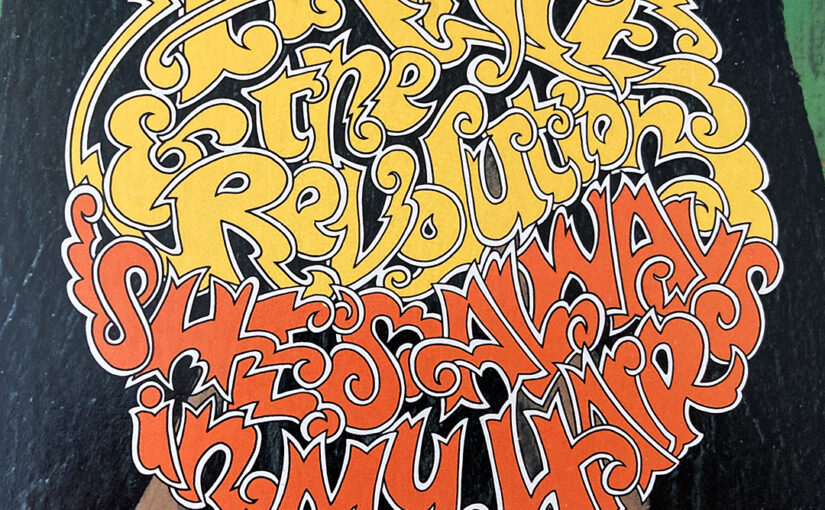

Controversy (1981)
As we walked into First Ave last summer, my friend warned me that it takes a lot to get him onto the dancefloor. We were only in the club five minutes before the kick drum to Controversy snapped his British reserve and he didn’t leave the floor for the rest of the night. He called it his kryptonite.
I could write lots of similar stories about other people’s reactions to this song. People LOVE Controversy. But I wanted to pin down my own feelings and shut out other voices. Ultimately, that didn’t work. Music can’t be heard in a vacuum and those reactions are as much a part of my experience as theirs.
I liked Controversy from the start – how can you not? – but discovering it via The Hits caused me to lump it in with his other early club hits. Even after buying the early albums, I’d always reach for 1999 over Controversy. That relationship changes after every listen with other people present. Hearing others’ spontaneous reactions always adds another layer to my snowballing love. Friends enthusiastically sing along when it’s on the radio. Crowds consistently go crazy when I’ve played my 7” picturedisc in an otherwise Prince-free set. These snapshots are a tapestry of joy that weaves itself around my relationship to the song. I’ll say it again – people LOVE Controversy.
As I struggled to put the appeal of Controversy into words, I used an old graphic design trick to get inspiration. I pushed all thoughts of the song to the back of my mind and went for a walk. With my subconscious chewing over the brief, my conscious mind was tasked only with observing. On this walk, a discarded CD in the road caught my eye. The sun reflected off its surface, flashing the most brilliant red light. I took another step and the flash turned orange. Another and it was yellow. And so on, throughout the whole visible spectrum. It was a beautiful laser show just for me. It put to mind the Tibetan buddhist belief of the rainbow body, which says at the moment of death during the ultimate stage of enlightenment, the physical body, instead of decaying, dissolves into coloured light rays.
After the walk, I came back to the question of Controversy to see if my writers block had lifted. The vision I described lent itself to a few metaphors about the reflected enjoyment of others but it all felt a bit tenuous. And then it hit me. It’s not what I saw, but the very act of seeing that is the key to Controversy.
To see transcendence in a piece of litter, I had to be receptive. I had to look without filters and be open to the unexpected. My mind, in its normal state, would have classed the CD as trash and moved on. But when practising deep observation – looking at what’s there and not what you expect to be there – it allows space for wonder. This is why Prince sings “I don’t understand human curiosity”. He doesn’t understand the kind of curiosity that seeks only to categorise and shut down further thought. As soon as you label something, you’re no longer perceiving it, you’re filing it away. The curiosity Prince understands is that of an artist. Following unknown paths. Tugging threads. Sitting with uncertainty. No-one can stay in a filter-free mindset all the time – it would be exhausting. But the more we look at the world like an infant, the more we notice. The more our model of the world widens. The more the universe grows.
Controversy mocks the journalists’ desire to define him. He’s not questioning his own sexuality, race or beliefs. He’s questioning your need to know. In those early years especially, Prince would embrace ambiguity to prevent people from putting him in a box. He would build a smokescreen of personal myths to defy pigeon-holes and labels. Of course this made people more eager to uncover the ‘truth’, but it wasn’t purely a cynical move to build up intrigue. It was simply that labels are reductive. Not colouring in all the lines allows freedom to exist outside people’s preconceptions. This is his fictional Uptown. However, it was while singing about this open-minded utopia that Prince got to experience the “downtown, nowhere-bound, narrow-minded drag” on a frightening scale.
On the day Controversy was released as a UK single, Prince and his band were booed off stage in the middle of Uptown, by a stadium of vitriolic Rolling Stones fans shouting racist and homophobic slurs. If the crowd had taken in the song’s message they may have heard some of Prince’s rockiest material. But as the set was fronted by a black man in bikini briefs and a trench coat, they weren’t hearing the music. You label something, you no longer perceive it.
Prince left the stage and vowed to bail on the second night but he rallied and returned two days later to finish a set in front of an even more hostile crowd. He didn’t back down. He didn’t even remove the triggering Jack U Off from the set list. Compromising and contorting to fit into others’ narrow confines would have been defeat. Three days later, the Controversy album was released into the world and for the follow-up he further blurred gender boundaries by combining male and female symbols into a glyph that would eventually evolve to become his name.
The grit and determination to not back down in the face of such naked hostility shouldn’t be under-estimated. It wasn’t just in that stadium where he faced intense pressure to conform to gender stereotypes. While rock had played with androgyny throughout the 70s, in the US the tide was turning. The Reagan era of ultra-conservatism had just started, while the Death to Disco backlash was still antagonistic against anything not deemed sufficiently macho. Soon David Bowie would be over-asserting his heterosexuality in Rolling Stone magazine, telling them that claiming to be bisexual was the biggest mistake he ever made. Not long later, Queen’s I Want to Break Free video was banned by MTV for promoting cross-dressing. It’s scarcely believable that anyone would once find the comical image of Freddie Mercury dressed as a housewife provocative, yet a similar hysterical backlash feels like it’s underway today.
A couple of years ago, it was more common to be accepting of people not fitting into traditional boxes. Now there seems to be a militant need to label and categorise. To divide and vilify. Culture wars are stoked by billionaires to keep us angrily engaged on their social media platforms, diverting our energy to direct hate towards each other instead of challenging the existing power structures. The world would be more like Uptown if we followed Controversy’s ethos of “life is just a game, we’re all just the same” and appreciated the messy beautiful world for what it is, instead of feverishly trying to compartmentalise it down. Prince signposted the way in the opening words of his seventh album: “open your hearts, open your minds…”
While all this delves into the message of Controversy, none of it explains the appeal of the music. I failed there. So I asked my friend what it was that made the song his kryptonite. He replied “it’s an enigma as it somehow manages to be a heavy funk monster and absolutely light as a feather at the same time”. Maybe that’s why it resisted my attempts to describe it. Words seek to define, but the message of Controversy is sometimes things don’t need to be defined. Sometimes, they should just be allowed to be.